
Nothing lasts forever.
For centuries, Usa Shrine and Rokugo Manzan had built a remarkable world together.
Faith supported the economy.
The economy supported the temples.
The temples supported the people.
The people cared for the mountains.
Everything depended upon everything else.
It was a world of balance.
But history rarely stands still.
The Shrine That Adapted
As Japan entered the age of the samurai, political power gradually shifted away from the old aristocracy and toward military rulers. Usa Shrine adapted remarkably well. The shrine increasingly emphasized Hachiman not only as the protector of the nation but also as the guardian of warriors.
The first shogun, Minamoto no Yoritomo, became one of Hachiman’s most devoted supporters, and the founding of Tsurugaoka Hachimangū in Kamakura helped spread Hachiman worship throughout Japan.
The shrine had successfully adapted to a changing age. Not everyone could.
When Rulers Stopped Fearing the Gods
The prosperity of Rokugo Manzan had been built upon a network of temples, landed estates, and communities that enjoyed considerable independence. For generations, this decentralized system had worked remarkably well.
But the Sengoku period — Japan’s century of civil war — demanded something different. Across Japan, powerful warlords sought to bring land, taxation, military force, and political authority under their direct control. Independent religious institutions increasingly came to be seen as obstacles to that goal.
The destruction of Enryaku-ji by Oda Nobunaga and the long conflict with the Ishiyama Hongan-ji were among the most famous examples.
Pause on what this means. Earlier in this story we saw a world where no ruler dared go to war without the sanction of the gods — where divine anger was as real as weather, just as Rome’s generals never marched without taking the auspices. That world was now ending. To the warlords of the Sengoku age, temples and shrines were no longer powers that could curse a realm into ruin. They were political and economic rivals — assets to be used, or obstacles to be removed. The invisible shield that had protected the temples for a thousand years — the fear of the gods — quietly dissolved.
Strip away the awe, and consider what the warriors now saw. Magnificent halls, gilded buddhas, storehouses filled with treasure — judged with a cold eye, these were accumulations of wealth on an extraordinary scale. We bleed in every campaign and struggle to govern the land, a warlord might reflect, while these men, exempt from tax and from military service, go on gathering riches. Nobunaga’s ruthlessness toward the great monasteries is often read as an emotional hatred of religion. Seen from the warriors’ side, it may have been something far more mundane: a campaign to take back what rulers had come to regard as their rightful share.
The same transformation eventually reached distant Bungo—the land of Kunisaki itself.
Ōtomo Sōrin and the End of the Old Order
In Bungo, that transformation had a name: Ōtomo Sōrin.
Today, Sōrin is often remembered as the Christian daimyō who destroyed Buddhist temples. The reality was more complicated.
At first, he protected many temples, including those of Rokugo Manzan, recognizing their influence within his domain. But as his efforts to strengthen central authority continued, the enormous economic and political power of the temple estates became increasingly difficult to tolerate.
Christianity may have influenced some of his later decisions. Yet the deeper conflict was political. The old religious network no longer fit the new age.
Many temples were destroyed.
Flames on the Mountainsides
Imagine the scene.
Wooden halls that had stood for centuries.
Libraries filled with Buddhist scriptures.
Living quarters for monks.
The sound of bells echoing through the valleys.
Then smoke.
Flames climbing the mountainside.
Roofs collapsing.
Silence.
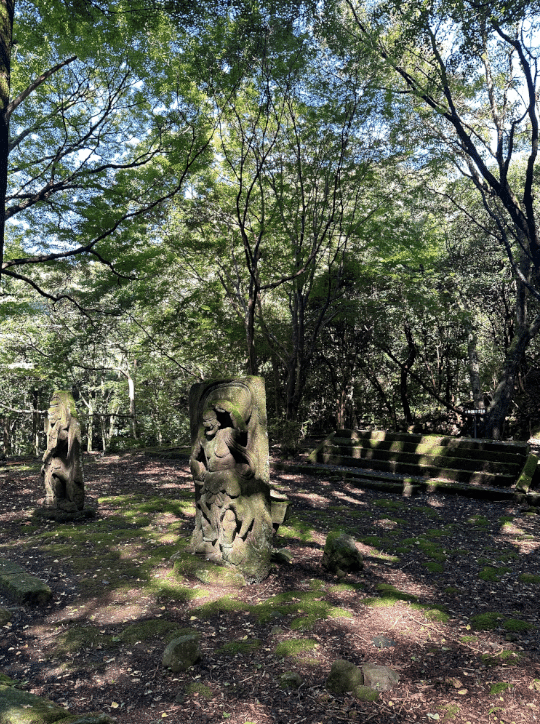
Traditions preserved at temples such as Sento-ji speak of magnificent buildings consumed by fire.
Other places tell different stories. At Iwato-ji, monks are said to have retreated to nearby mountain fortifications and resisted. At Tennen-ji, some remote training sites hidden deep in the mountains survived, later becoming the foundation for rebuilding.
How much of this is history, and how much legend? Fires there certainly were. But precise records are scarce, and some of the tales surely carry later embellishment. Nor was Sōrin’s hand behind every blaze: in the final years of the Sengoku age, the war between the Ōtomo and the invading Shimazu swept the whole of Bungo with fire. The destruction was real — but the storytelling around it grew with time.
The Deeper Collapse
Yet even without war, Rokugo Manzan would have faced profound challenges. Its greatest strength had always been the economic system that sustained it. As the medieval estate system declined and military rulers consolidated direct control over the countryside, maintaining such a vast religious network became increasingly difficult.
The age that had created Rokugo Manzan was disappearing.
The wooden halls burned.
The economic network was broken.
The old order came to an end.
What Fire Could Not Burn
But not everything was lost.
Fire could consume timber. It could not consume stone.
The stone stairways remained.
The stone Buddhas remained.
The cliffs where generations of monks had prayed remained.
And so did the people who remembered.
Rokugo Manzan had lost its world. It had not lost its soul.
From those ashes, a quieter chapter of its story would begin.
Worth a Visit: A Great Temple Returned to Grass — the Ruins of Old Sento-ji
Sento-ji, whose burning we met above, was no minor temple. Tradition holds it was the very first temple Ninmon founded — the head of sixteen branch temples, so grand it was called “the Mount Kōya of the West.” Even its name is legend: as Ninmon practiced in a rock cave high on the ridge, the Dragon King of the sea, moved by his devotion, offered him a thousand lanterns. Sento-ji — the temple of a thousand lights.
Its great halls are said to have been lost in the burnings of the late sixteenth century. Walk the old approach today and you pass the sites of one monastic lodging after another; on a terrace of massive stones stands the platform where the goma hall once rose. Apart from the rebuilt inner sanctuary, not a single wooden building remains. And precisely because nothing has been half-heartedly reconstructed, the place seizes the imagination. Standing among the stone walls and foundation stones, you can almost see the halls that once climbed this mountainside — and the flames you have just read about.
Beyond the inner sanctuary, the woods suddenly fill with stone: a vast gathering of gorintō, five-ring pagodas, said to number a thousand. Ordinary people offered them in the early Edo period to celebrate the temple’s revival, and they accumulated year upon year — among them, quietly, stands a Kunisaki-tō said to mark Ninmon’s own grave. How deeply people cherished this burned temple, the stones say without words.
Climb on along the ridge and you reach a huge rock shelter near the summit: Itsutsuji Fudō, a holy site thought to have served mountain ascetics since early times. And tradition says it was here, in this very cave, that Ninmon received the Dragon King’s thousand lights. At the top of this path, in other words, the beginning of the story is waiting.
For driving access, parking, and walking routes, the Kunisaki City Tourism Association’s map is a great help.
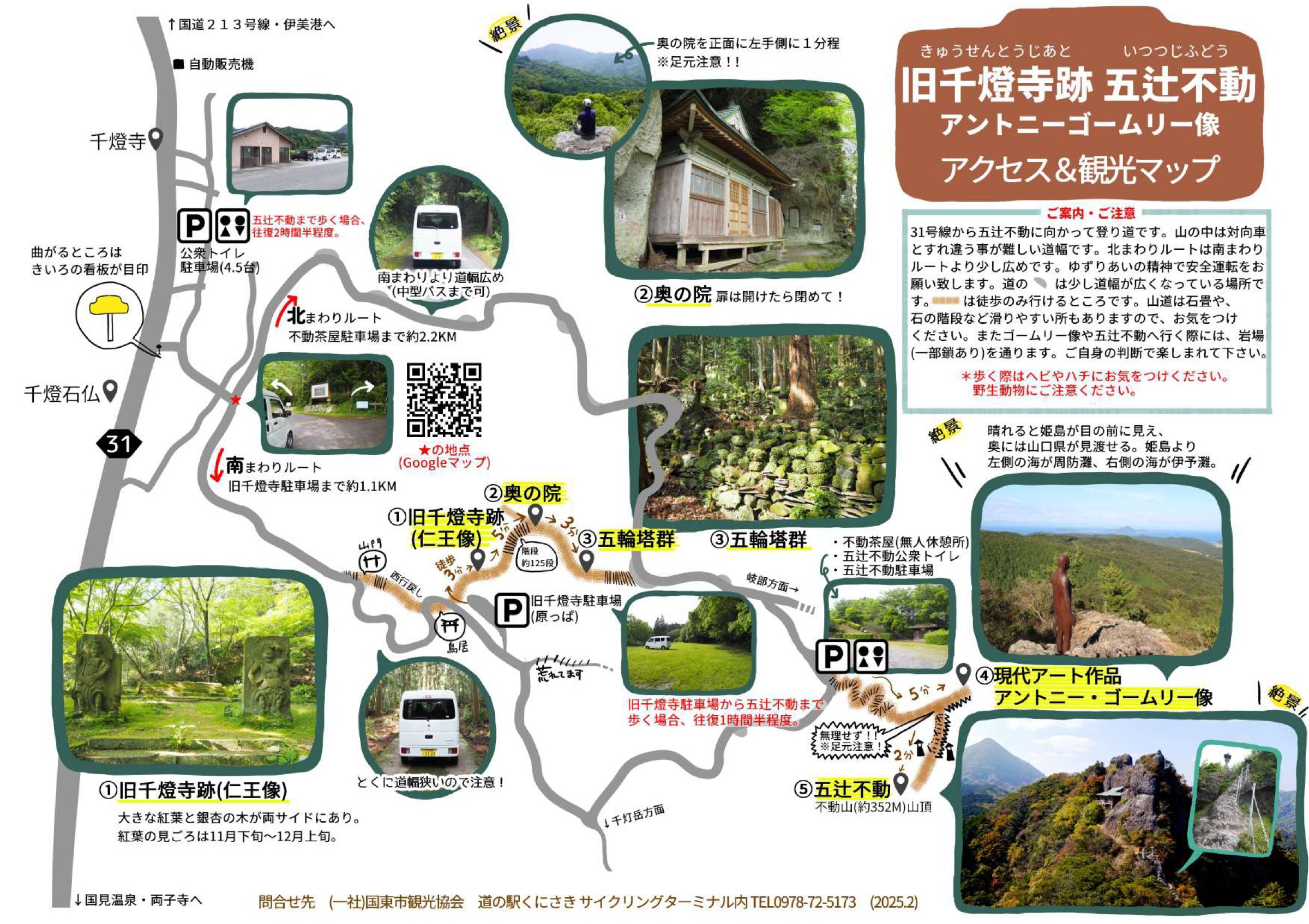
Old Sento-ji ruins & Itsutsuji Fudō — access and sightseeing map (in Japanese)
(courtesy of the Kunisaki City Tourism Association / click to enlarge)
Send a comment
Comments are not published on this page. They go directly to the site owner.