
By the twelfth century, Rokugo Manzan was no longer simply a religious community. It had become a way of life.
A Day in the Life, Eight Hundred Years Ago
Imagine spending a day on the Kunisaki Peninsula eight hundred years ago.
At sunrise, monks climb narrow mountain paths toward hidden caves and rocky peaks, where they begin another day of training.
Below them, farmers step into flooded rice fields, tending the paddies that will feed both their families and the temples.
Along the coast, boats wait in quiet harbors, ready to carry rice, timber, salt, and travelers across the Seto Inland Sea.
Meanwhile, bells ring from village temples, priests prepare rituals at local shrines, and pilgrims begin their journeys from one sacred place to another.
None of these people lived separate lives. They belonged to the same world.
An Economy of Faith
The economic foundation of that world was the shōen, or private landed estates, that had expanded across the region.
Rice harvested in the valleys supported temples and shrines.
Temples prayed for good harvests and cared for the spiritual life of the villages.
The villages maintained roads, bridges, and pilgrimage routes through the mountains.
Pilgrims, merchants, and monks carried not only goods, but also stories, news, and new ideas from one community to the next.
Everything supported everything else. Faith and daily life were inseparable.
As Rokugo Manzan prospered, its temples became more than places of worship.
They were schools.
They were centers of learning.
They offered practical knowledge as well as spiritual guidance.
Some monks helped improve irrigation or advised farming communities.
Others organized the repair of roads and bridges or welcomed travelers arriving from distant provinces.
Religion was woven into the everyday life of the peninsula.
The Village Gods Never Left
So far, monks and temples have carried this story. But look down, at the villagers’ feet, and another faith is quietly thriving. At the intake of an irrigation channel stands a small shrine to the water god. The rice fields have their deity; so do the mountains. At every point where a harvest could be won or lost, people kept praying to the old gods, just as their ancestors always had.
And in this age, the bond between gods and buddhas grew deeper still. An idea was spreading across Japan: the kami were the buddhas themselves, taking familiar local form to save the people. At Usa, Hachiman came to be understood as a manifestation of Amida Buddha. The temples of Rokugo Manzan enshrined guardian gods within their own precincts. Shrines hung kakebotoke — sacred bronze mirrors embossed with the face of a buddha. And the god who had once taken Buddhist vows was now carved in statues wearing a monk’s robes.
A buddha, or a god? By now, no one could quite say — and no one minded. The fusion of gods and buddhas born at Usa truly came into bloom, in doctrine and in everyday life alike, in precisely this age.
Mountains, Trails, and Tides
The mountains, too, were constantly alive. Groups of ascetic monks walked from temple to temple, following demanding training routes across steep ridges and through deep forests. Among the most important were the dramatic rock formations around Tennen-ji and the rugged landscape now known as Nakayama Senkyō.
These were not isolated holy places. They were part of a living network that stretched across the entire peninsula.
Even the sea played its part. Boats carrying annual rice taxes also carried pilgrims. Merchants exchanged not only goods but information. Ideas traveled with the tides. The same sea that had once brought Buddhism to northern Kyushu continued to connect Kunisaki with the wider world.
The Kunisaki You See Today Was Born in This Age
Much of what visitors now recognize as “Kunisaki” took shape in these prosperous years.
The Kunisaki-tō — the peninsula’s own style of stone pagoda, rising from a carved lotus pedestal — appeared now; the oldest dated example, at Iwato-ji, bears an inscription from 1283. The wealth of the estates was turning into stone, carved with prayers for the dead and for peace in this life. Most of the great cliff-carved buddhas, the magaibutsu, are thought to date from around this time as well — the harvest of the estates made visible in rock, just as we glimpsed in the Tashibu valley. So does the graceful Amida hall of Fuki-ji, the oldest wooden building in Kyushu.
And then there are the festivals. In Tendai temples across Japan, the New Year brought a rite of prayers for a good harvest. In Kunisaki, that rite merged with demon-quelling and fire festivals to become something found nowhere else: Shujō Onie, the demon rite. Everywhere else in Japan, oni — demons — are driven away. In Kunisaki, they are welcomed. The oni is a messenger of the Buddha: it raises a blazing torch, goes from house to house, purifies each with fire, and hands out blessings. A temple ceremony in which villagers shoulder the torches — prayer and daily life fused into a single night of fire. It is still performed today at Tennen-ji, Jōbutsu-ji, and Iwato-ji.
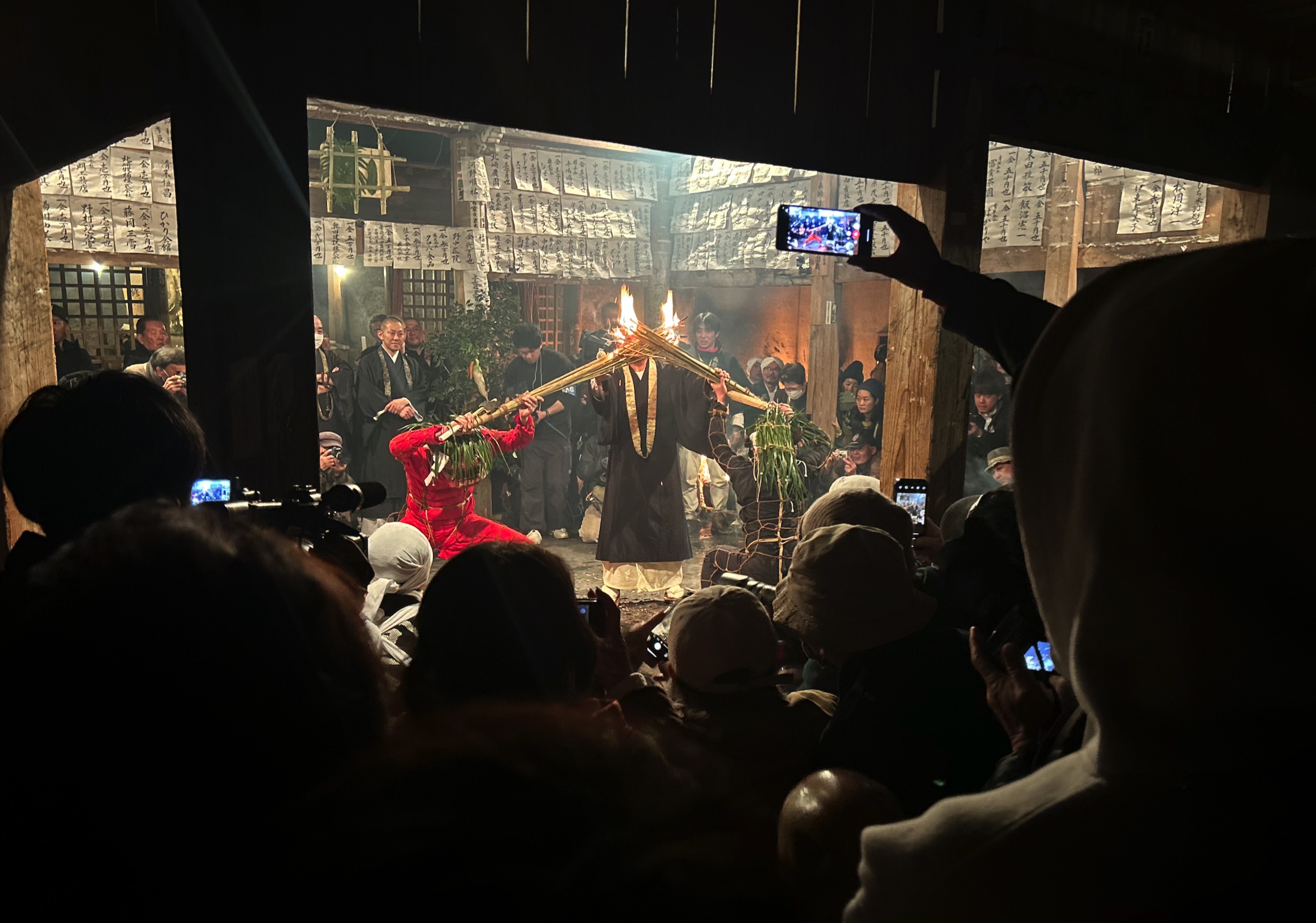
Shujō Onie — an oni raises its burning torch in the temple hall
(click to enlarge)
By this period, the yearly round of rites and gatherings was being set down in writing. The prototype of nearly everything we now call “Rokugo Manzan culture” was assembled in this one age.
And tradition says that Shujō Onie, too, was founded by Ninmon, who gathered the monks of the twenty-eight temples to teach it. Ninmon, again. So who, exactly, was Ninmon?
A Community Tells Its Origin Story
As the community grew, it also began telling a story about itself. At the center of that story stood Ninmon Bosatsu.
According to tradition, Ninmon traveled throughout the peninsula under the guidance of the deities of Usa, establishing temples, opening sacred training sites, and laying the foundations of Rokugo Manzan. Modern historians cannot say with certainty whether such a person actually lived.
Here, then, is the answer promised earlier: the legend took its written shape in this very age of prosperity — centuries after the events it describes. That is no coincidence. A great institution needed an origin story worthy of its greatness. And in a world where temple lands and privileges were increasingly contested, a founding legend starring an incarnation of Hachiman was more than poetry. It was armor.
But perhaps authenticity is not the most important question. Every great community tells stories about its beginnings.
Whether historical or legendary, Ninmon came to represent the ideals of Rokugo Manzan itself—the monk who united mountains, temples, and people into one sacred world.
A World That Seemed Complete
By this time, dozens of temples stood across the peninsula. Hundreds of monks and mountain ascetics walked its trails. Villages, shrines, temples, forests, fields, and harbors all formed part of a single living landscape.
Rokugo Manzan was never simply a collection of temples. It was an entire society built around faith.
For generations, the system seemed complete.
The mountains sustained the monks.
The monks guided the people.
The people cultivated the land.
The land supported the temples.
Everything was connected.
It seemed as though this world might last forever.
It would not.
Worth a Visit: Giants on the Rock Face — the Kumano Magaibutsu
Of all the cliff-carved buddhas of Rokugo Manzan, the largest by far are the Kumano Magaibutsu (site in Japanese) near the Tashibu valley: a Fudō Myōō about eight meters tall and a Dainichi Nyorai about seven. To eyes accustomed to modern mega-structures — or to the great temples and buddhas of the capital, built with wealth gathered from across the nation — they may look almost modest. But consider what it meant to carve them here, high in the Kunisaki mountains, in an age without machines or power tools.
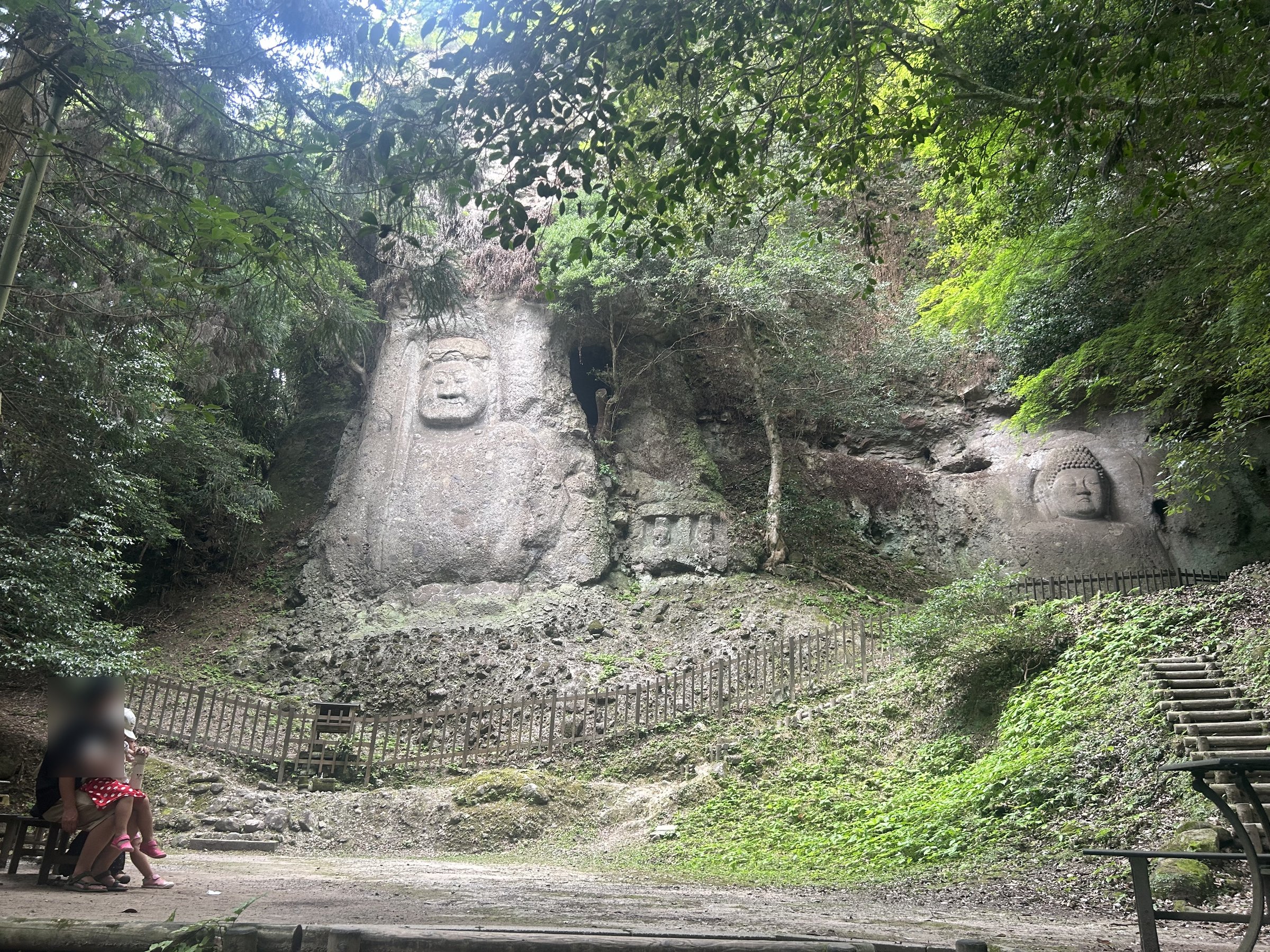
The Kumano Magaibutsu — Fudō Myōō (left, about 8 m) and Dainichi Nyorai (right, about 7 m).
The figures at lower left give a sense of the scale. (click to enlarge)
These were never buddhas for display. Unlike the later works of professional stonemasons found elsewhere in Japan, the buddhas of Rokugo Manzan were carved by the monks themselves, as an act of training. Taizō-ji, the temple at the foot of the cliff, is said to have kept its own smithy to forge the chisels. Yet a project of this scale could never have been carried through by a temple alone. It plainly rested on the support — in goods, in labor, in goodwill — of the people around it: no better proof of the region’s prosperity, and of how deeply religion ran through everyday life.
The carvings are watched over by a Kumano shrine at the top of the stone stairway. The Kumano faith sprang from the sacred mountains of Kii (present-day Wakayama) and swept across Japan in precisely this period — at the time, it was a brand-new devotion. Kunisaki was not merely preserving traditions handed down from the seventh and eighth centuries; open to the Seto Inland Sea, it kept absorbing the newest currents and evolving.
A Tendai temple below, a Kumano shrine above — here too, gods and buddhas share a single sacred site. Taizō-ji’s founding legend reaches back to the early eighth century. How old it truly is, no one can say; but it had clearly been rooted here for a very long time. On that foundation, at some point, this colossal carving was accomplished — and, a little later, the gods of Kumano came to watch over it.
One more thing. The rough stone stairway is said to have been piled up by an oni in a single night — ninety-nine steps. An oni, again. In the tales of Kunisaki, a demon shows up at every important turn.
And Taizō-ji is where today’s mine-iri sets out: the mountain path we met in the last chapter still begins at this temple.
Send a comment
Comments are not published on this page. They go directly to the site owner.