
Rokugo Manzan did not suddenly appear. Like everything else in the story of Kunisaki, it grew gradually — and, as we will see, it grew the way the peninsula itself was built: layer upon layer, with nothing ever quite replaced.
By this time, temples and mountain training sites were scattered across the peninsula. They shared many beliefs and practices, but each still functioned independently.
What transformed them into a single community?
A Legend — and What Actually Happened
In later centuries, Rokugo Manzan would tell its own origin story. In the year 718, the story goes, a monk named Ninmon — an incarnation of Hachiman himself — walked the valleys of Kunisaki and founded twenty-eight temples. This is the tradition we met at the end of the last chapter: the god who took Buddhist vows, choosing these very peaks as his place of practice.
It is a beautiful story. It is also, historians agree, a story composed centuries after the fact — written down when Rokugo Manzan had grown powerful and needed a founding legend worthy of its stature. We will see why, and when, later in this tale.
The real growth was slower, quieter — and just as remarkable.
Under Miroku-ji’s Umbrella
The story begins at Miroku-ji, the Buddhist temple within the Usa shrine complex. While the shrine served the kami, Miroku-ji carried out Buddhist rituals. Through it, monks and temples across the Kunisaki Peninsula maintained loose connections, sharing teachings, rituals, and pilgrimage routes.
Picture it as a great umbrella: Usa and Miroku-ji holding the canopy, and the mountain temples gathered beneath it, each still going its own way. They already formed a network. They simply did not yet think of themselves as one community.
And here is something worth noticing before we go on: that umbrella never folds. Through every chapter that follows, the wealth and prestige of Usa and Miroku-ji remain the ground the mountain temples stand on. Everything Rokugo Manzan later becomes is built on top of this foundation — never in place of it.
Mountain Buddhism, a Wind from the Capital
At about the same time, Buddhism itself was changing. In the Nara period (eighth century), Buddhism had largely served the state. But during the early Heian period (ninth century), new schools of Buddhism began looking toward the mountains instead of the court.
The most influential was Tendai Buddhism, founded by the monk Saichō on Mount Hiei near Kyoto. Tendai emphasized spiritual practice in the mountains. Yet for the monks of Kunisaki, this was not an entirely new idea. They had already been climbing ridges, meditating in caves, and training among forests and cliffs for generations.
There was no day on which the peninsula “converted.” Tendai arrived the way weather arrives — a wind from the capital, drifting from mountain to mountain, monk to monk, over generations. Tendai did not invent mountain practice in Kunisaki. It gave those existing traditions a shared language, a broader vision, and a place within the wider world of Japanese Buddhism. Life under Miroku-ji’s umbrella went on as before; only its color slowly deepened into Tendai.
Six Districts, Three Roles — and a Council of Mountains
Gradually, the temples of the peninsula began organizing themselves.
Monks traveled more frequently between valleys.
Training methods became increasingly shared.
Ceremonies grew more consistent.
Out of this growing traffic came a rite of passage. Novice monks began to walk the full circuit of peaks that Ninmon was said to have opened — tracing the founder’s footsteps ridge by ridge, valley by valley. Legend has it that in the ninth century Ninmon himself appeared before a monk to show the way. Only after walking the whole mountain path was a newcomer counted a true ascetic. The practice, later called mine-iri — “entering the peaks” — continues, in changed forms, to this day.
The scattered temples slowly became a single religious community. The peninsula was organized into six districts — Rokugō, “the Six Districts” — and the temples took on three distinct roles:
- Honzan temples provided leadership and scholarship
- Nakayama temples led mountain training
- Suezan temples cared for the spiritual life of the villages
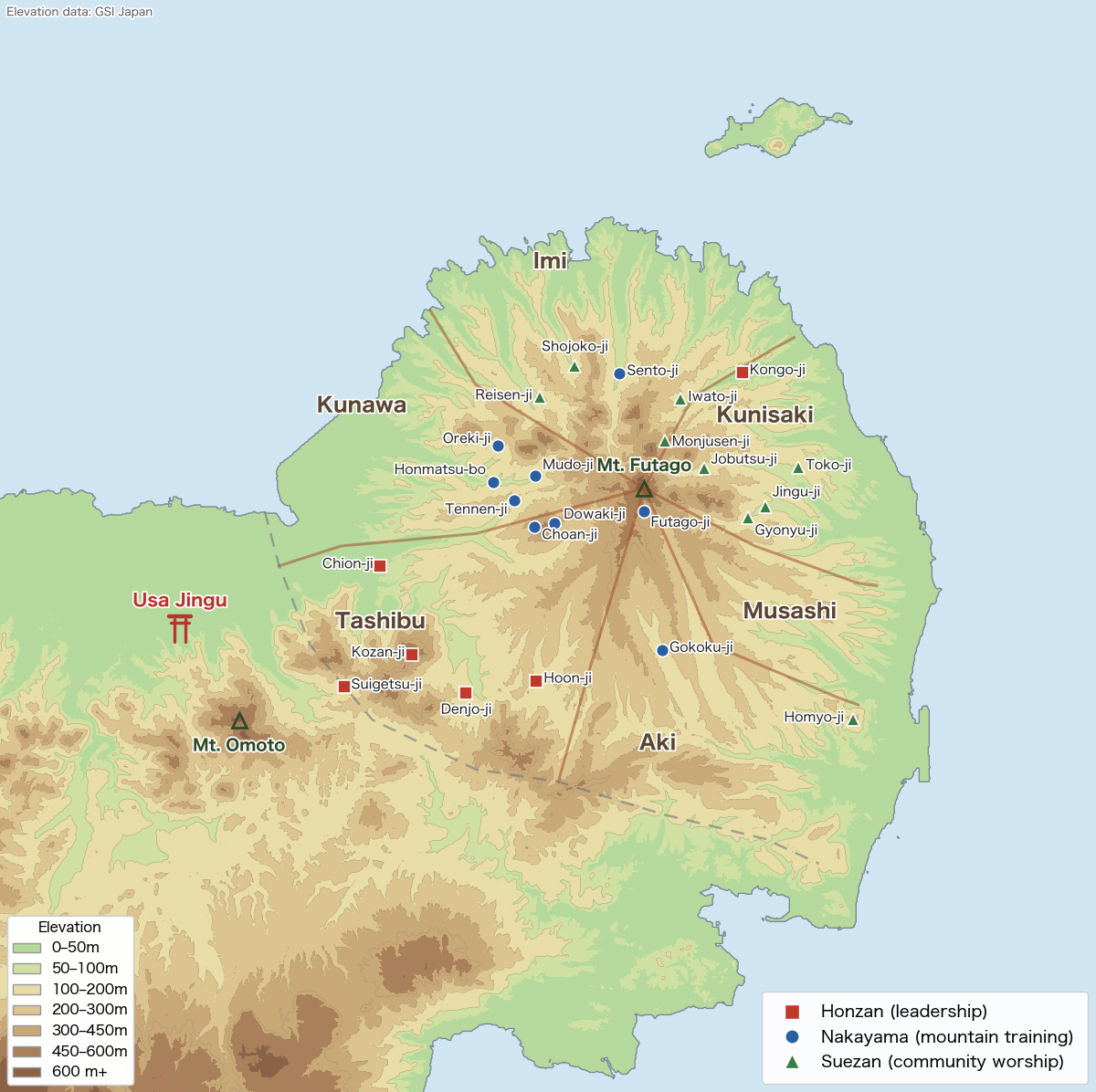
The Honzan, Nakayama, and Suezan temples of Rokugo Manzan
(24 of the 28 traditional temples whose locations are known, approximate positions.
Temple locations after “Kunisaki Rokugo Manzan” (Mokuseisha) and others. Elevation data: GSI Japan / click to enlarge)
Look at the map for a moment. The training temples of Nakayama ring the central peaks, each standing where a valley meets the mountains — at the boundary between the world of villages and the world of ascetics. The pattern of the volcano, the valleys, and the faith is all there in a single image.
Just as remarkable as the structure was the way it governed itself. Many religious institutions are built around a single powerful leader. Rokugo Manzan was not. Its temples worked through consultation. A head temple — the sōzan — served as coordinator, but important matters were settled by representatives of the temples gathering and seeking consensus. It was less like a kingdom than a federation.
And here the layers show themselves clearly. In these same years, the temples of the six districts were also joining the family of Enryaku-ji, Tendai’s great headquarters on Mount Hiei — taking their place, at least on paper, in a hierarchy that ran all the way to the capital. Self-rule by consensus, and the banner of a distant authority: the two did not cancel each other out. They grew up side by side.
Nothing Was Ever Replaced
Step back, and the making of Rokugo Manzan looks like the peninsula’s own geology.
At the bottom, the umbrella of Usa and Miroku-ji — the economic and spiritual bedrock. Above it, the slow-settling wind of Tendai. And on top, a homegrown way of running things: six districts, three roles, and a council of mountains.
What matters is that each new layer settled onto the one below without erasing it. The temples never let go of Miroku-ji’s support. They kept a real measure of independence through their councils. And they accepted Tendai’s teachings and Tendai’s authority. Whenever the world around them shifted, Rokugo Manzan did not switch from one identity to another — it rebalanced the layers it already had.
One mountain still carries the proof in its name. The sōzan — the seat of the temples’ own self-rule — called itself Mount Saiei: “Western Hiei,” after Tendai’s great headquarters near Kyoto. A council of local mountains, wearing the name of the capital’s holy mountain. No document states the coexistence more eloquently than that.
Out of these layers, something larger emerged. For the monks, the entire peninsula became a place of practice. For the villagers, every valley became part of a sacred world. The mountains were no longer simply mountains; the villages no longer simply villages. Forests, cliffs, shrines, temples, and pilgrimage paths together formed a single religious landscape — a peninsula given over to faith, of which the world offers few parallels; Mount Athos in Greece may be the closest cousin this place has.
The stage that volcanoes had created millions of years earlier — itself built layer upon layer — had finally found its purpose.
In the next chapter, we look at the bedrock that made it all possible: the estates, the harvests, and the economy of faith that let Rokugo Manzan embrace the entire peninsula.
Worth a Visit: The Mountain That Led Them All — Mount Saiei and Kōzan-ji
The role of sōzan — coordinator of all the Rokugo Manzan temples — is said to have first belonged to Kōzan-ji, on Mount Saiei, the mountain rising west of the Tashibu valley.
The mountain’s name tells you everything about its ambitions: Saiei-zan means “Western Hiei,” a deliberate echo of Mount Hiei, the great Tendai headquarters near Kyoto. Tradition even counted it among “Japan’s three Hiei,” alongside Mount Hiei itself and Tōeizan in Edo. In the Heian period, Kōzan-ji stood at the head of the sixty-five temples of Rokugo Manzan.
The leadership later passed to Chōan-ji, and the halls on the heights were lost to time. The present Kōzan-ji (site in Japanese) carries the temple’s name and flame today.
Mount Saiei looks down on the Tashibu valley — the medieval estate we walked in an earlier chapter. Seen from here, the harvest in the fields below and the prayers on the mountain above were two halves of a single world.
Send a comment
Comments are not published on this page. They go directly to the site owner.