
History does not always unfold as governments intend.
As Yamato expanded its authority across Japan, one might expect local communities to lose their independence and become increasingly controlled by the central government.
Instead, something rather unexpected happened.
The Logic of the Plains, the Logic of the Valleys
For generations, people had already been farming the land, managing irrigation, maintaining villages, and worshipping their local deities. Regional leaders had long served as the organizers of both agriculture and community life.
The new Ritsuryō government provided a common legal framework, and in broad fertile plains, where disputes over land and water were frequent, that brought obvious advantages. But much of Japan was not made up of broad plains. It was a land of mountains, valleys, and peninsulas.
In places like the Kunisaki Peninsula, each valley already functioned as a self-contained community. People knew their own fields, managed their own irrigation systems, and relied on local cooperation to survive. Here, distant officials from the capital could never understand the land as well as the people who lived there.
A Clever Arrangement: Donate the Name, Keep the Land
Gradually, another system emerged. Rather than resisting the central government, local leaders chose to work with it — in a wonderfully pragmatic way.
They donated their land to influential aristocrats, great temples, or major shrines connected to the imperial court. But “donation” here did not mean packing up and leaving. What changed hands was the name on the deed. The local family sent a share of each harvest to the new nominal owner in the capital; in exchange, that owner’s prestige shielded the land. And the actual management of the fields — along with the rest of the harvest and all the real decisions — stayed exactly where it had always been: in local hands.
Put a powerful patron’s name over the gate, and keep the keys. It is an arrangement any modern reader will recognize.
The deal benefited everyone.
The court’s elite gained income without lifting a hoe.
Temples and shrines gained new sources of support.
And local families kept their land — now with powerful protection.
These estates are known as shōen.
A Tax Dodge — or Something Smarter?
Japanese schoolbooks sometimes describe the shōen as a tax dodge — land slipped out of the state’s ledgers. From the government’s point of view, that is not wrong: taxable land shrank, and revenues suffered.
But look at it from the valleys, and a different picture appears.
A governor posted from the capital served a few years and went home. A local family lived on the same land for generations. In places like Kunisaki and Usa, it was these rooted families — and the local temples and shrines — who dug the waterways, built the ponds, and opened new fields, investing for a payoff their children and grandchildren would see. Production rose, the population grew, and the region prospered. For farmers, too, life under a committed local patron was often steadier than life under a rotating state bureaucracy.
The shōen had real problems — a powerful estate lord could exploit as well as protect. But at its heart, the shōen was a mechanism by which local people used the authority of the center to protect and develop their own land.
How the System Spread
Donation to the powerful spread across the country as the standard way to put an estate on a legal footing. Estates with prestigious patrons eventually won formal immunities: exemption from taxation, and even the right to refuse entry to provincial officials.
Religious institutions became some of the greatest landholders of all. Readers who know medieval Europe will find this familiar: great monasteries like Cluny drained marshes, cleared forests, and became the economic engines of their regions. Japan’s great temples and shrines played much the same role — their estates funded not just worship, but development, engineering, and art.
One more thing was quietly taking shape inside this arrangement: a structure in which central prestige and local muscle depended on each other. Generations later, that structure would help shift power from aristocrats to warriors. But that is a later chapter.
Usa Between Two Worlds
Few places were better positioned to benefit from this new world than Usa Jingu.
To the west stretched the fertile plains of Toyo, capable of producing abundant rice. To the east lay the deeply folded valleys of the Kunisaki Peninsula, where independent mountain communities had flourished for centuries.
Usa stood between these two worlds. Supported by both the agricultural wealth of the plains and the spiritual traditions of the mountains, the shrine grew into one of the most influential religious centers in Japan. And the harvests of its estates would one day pay for things far more lasting than rice: mountain halls, stone Buddhas, an entire sacred landscape.
Ironically, a system designed to strengthen the authority of the central government also strengthened the regions themselves.
And among those regions, few would prove more remarkable than Kunisaki.
A powerful shrine was rising in Usa. Soon, another force would begin to rise beside it.
The monks had arrived.
Worth a Visit: Tashibu-no-Shō, a Medieval Estate You Can Still Walk
Tashibu-no-Shō, in the Tashibu valley of Bungotakada, developed in the Kamakura period as an estate of Usa Jingu. It is one of the very few places in Japan where the landscape of a medieval shōen survives to this day.
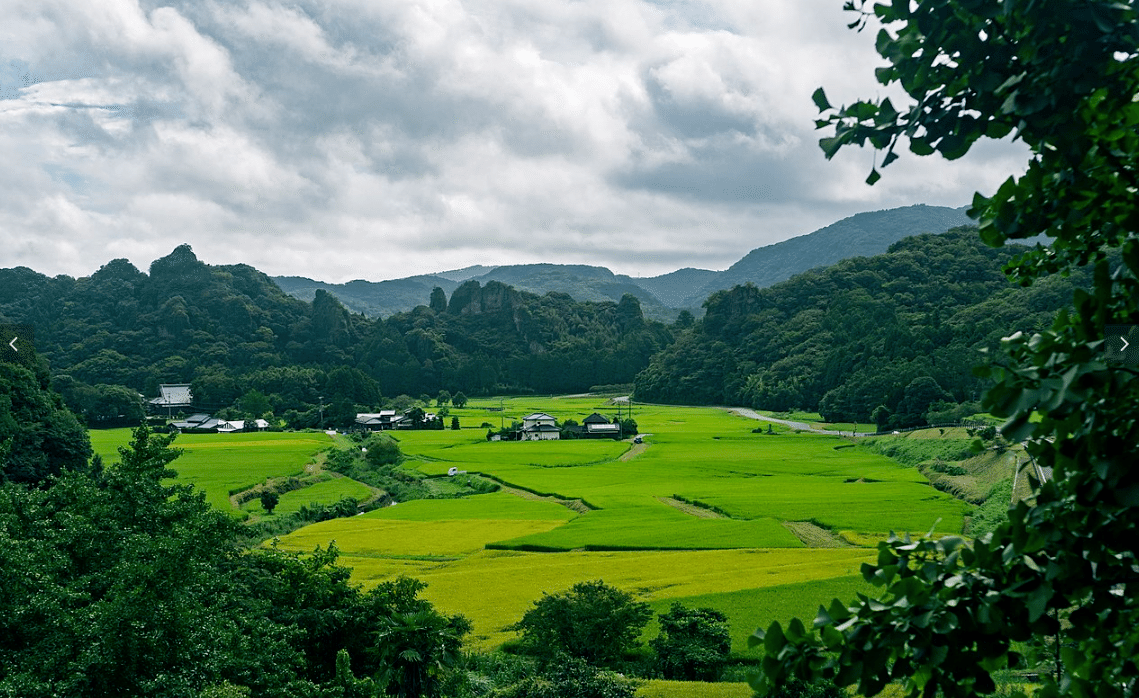
The terraced paddies and hamlets you see today are not literally medieval. But rice has been grown continuously in this valley for close to a thousand years, and the layout of fields and waterways still follows the medieval pattern. In and around the valley stand reminders of what estate wealth built: the ruins of Kōzan-ji, once head temple of Rokugo Manzan; Fuki-dera with its ancient wooden hall; and the great cliff-carved Buddhas of Kumano.
Walking here, you can feel with your own feet how a prosperous estate supported daily life — and how that prosperity, in turn, nurtured temples and a culture of stone.
The walking guide “The Estate Heritage and Rock Peaks of Tashibu” (Koji Note, in Japanese) introduces a model course through the area, including the cultural background of each spot. A course map is available at the link.
Send a comment
Comments are not published on this page. They go directly to the site owner.