
By the seventh century, the rulers of Yamato faced a difficult question. How could they govern an archipelago filled with powerful regional leaders, each with its own traditions, beliefs, and political influence?
Part of the answer arrived through an unexpected tragedy.
The Fall of Baekje and a Hard Lesson at Sea
For centuries, Japan had maintained close ties with the Korean kingdom of Baekje. Craftsmen, monks, scholars, and skilled artisans had long crossed the sea, bringing with them new ideas and technologies.
Then, in 660 CE, Baekje fell. Many members of its royal family, officials, scholars, and craftsmen fled to Japan, bringing with them not only their skills but also firsthand knowledge of one of East Asia’s most advanced civilizations.
Only a few years later, Yamato attempted to restore its ally by sending a large military force to the Korean Peninsula.
The campaign ended in disaster. In 663, Yamato was defeated by the combined forces of Tang China and Silla in what is now known as the Battle of Baekgang.
The defeat was a turning point. Rather than turning inward, the Yamato court began asking a different question:
“What can we learn from the civilizations that defeated us?”
The answer was ambitious. Yamato welcomed the refugees from Baekje and eagerly adopted many elements of continental civilization—Buddhism, writing, systems of law, and new models of government inspired by China.
A Japanese-Style State: Governing by Alliance
Yet Japan did not simply copy what it imported. The legal system known today as the Ritsuryō Code was based on Chinese models, but it was adapted to fit Japanese realities. China’s imperial government sought direct control over every part of its territory.
Japan took a different approach. Rather than replacing powerful local families, Yamato recruited them. Regional leaders became district governors, responsible for maintaining official records, collecting taxes, and administering their own communities on behalf of the central government.
In return, they retained much of their local authority and prestige. For many local leaders, this was a practical choice. Joining the new state offered military protection, political stability, and recognition, while allowing them to preserve the traditions that had long defined their communities.
Instead of ruling entirely through force, Yamato built alliances.
Instead of destroying regional cultures, it found a place for them within a larger political system.
This flexibility became one of the foundations of the early Japanese state.
The Regions That Made the System Work
As the authority of Yamato expanded, Japan gradually became more unified. Yet it never became culturally uniform. Across the archipelago, ancient regional traditions continued to flourish beneath the new political framework — and in fact, the system depended on their strength.
One of the strongest of these regional cultures lay in Toyo Province, around present-day Usa and Kunisaki. Here, local beliefs remained vibrant even as the new state took shape. In the centuries that followed, those traditions would give rise to Usa Jingu — and eventually to the remarkable religious world of Rokugo Manzan.
A Local God — Not Yet a God of War
The god of Usa was Hachiman.
If you have read about the samurai, you may have met Hachiman before, as “the Japanese god of war.” But he did not begin that way. For the people of Toyo, Hachiman was a local guardian — a god of good harvests, of the sea’s bounty, of the community’s everyday well-being.
In the eighth century, that role began to change dramatically.
When Legitimacy Came from the Gods
The Yamato court was building its new state and drawing the whole archipelago into it. But this “gentle unification” was not accepted everywhere. On the southern and northern edges of the archipelago — among the Hayato of southern Kyushu and the Emishi of the northeast, peoples who had always lived outside the Ritsuryō framework — tensions kept breaking into open conflict.
To fight such wars, the court needed more than soldiers. It needed to know that the war was sanctioned by the gods.
To modern readers, “divine sanction” may sound like political theater. It was anything but. For the people of this age, the will of the gods was a force that moved reality itself — as real as weather or disease. Wage war against the gods’ will, and their anger would strike back as epidemics, crop failures, and defeat. Soldiers believed this. So did the rulers themselves. An army that doubted the gods were on its side simply would not hold together. Ancient Rome knew the same logic: no Roman general marched without first taking the auspices. Consulting the gods before battle was not an empty ceremony — it was serious preparation, as vital as reading the weather or scouting the enemy.
And when the court needed such an answer, one name came up again and again: the oracle-giving god of a regional culture in Kyushu — Hachiman of Usa.
The Oracle That Moved a Nation
When the Hayato rose against the new state, the court prayed to Usa for victory. According to records kept at Usa, Hachiman answered with an oracle: “I myself shall go and subdue them.” The campaign succeeded, and the court credited the victory to the power of the god of Usa.
We cannot verify the oracle today, of course. What mattered was that the court came to believe that the words of the god of Usa could be relied upon. Just as villagers had once brought their questions about harvests and floods to their gods and accepted the answers as the community’s decision, the Ritsuryō state now sought oracles for its own great decisions. The community had simply grown — from a village to a nation. With each such event, Hachiman’s presence grew, and people began to see him as a god who leads the way in battle.
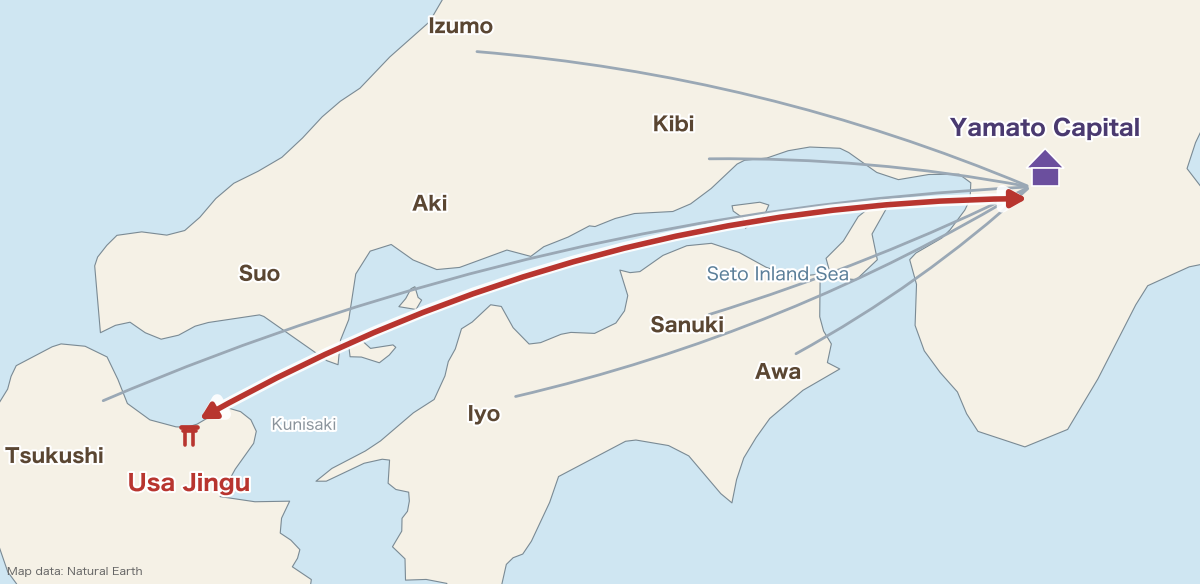
Every region was bound into the Ritsuryō state — but Usa, through its oracles,
became something more: a god the court relied on
(Map data: Natural Earth / click to enlarge)
And so Usa Hachiman was not swallowed up by Yamato. Through its oracles, this regional god became a trusted partner of the court — a deity the growing nation leaned on.
Meanwhile, just next door to Usa’s shrine, something else was quietly gathering strength: monks who practiced in the mountains. A god deeply trusted by the state, and ascetics of mountain Buddhism — when these two met, a world found almost nowhere else on earth would be born: the world where kami and Buddhas walk together.
Column: After the Battle — the Hayato and the Hōjō-e
For the court, the subjugation of the Hayato displayed the divine power of Hachiman. But seen from the Hayato’s side, it was the story of an independent people being absorbed into a central state.
In Usa, a ritual is said to have begun as a way of consoling the spirits of those who died in that war: the Hōjō-e, in which captured fish and birds are set free. It is a Buddhist rite, rooted in the Buddhist precept against taking life.
Think about what that means. A shrine dedicated to a god who leads armies adopted a Buddhist ceremony of atonement for killing. It looks like a contradiction — yet here is precisely the exquisite balance of kami and Buddha: thank the god for victory, and entrust the grief of its cost to the mercy of the Buddha.
Victory alone was not allowed to be the end of the story. The lives lost were also to be mourned. The seed of the world that would later flower in Kunisaki — where gods and Buddhas walk together — was perhaps already planted here.
Near Usa Jingu, a small shrine dedicated to the spirits of the Hayato — Hyakutai Shrine — still stands today.
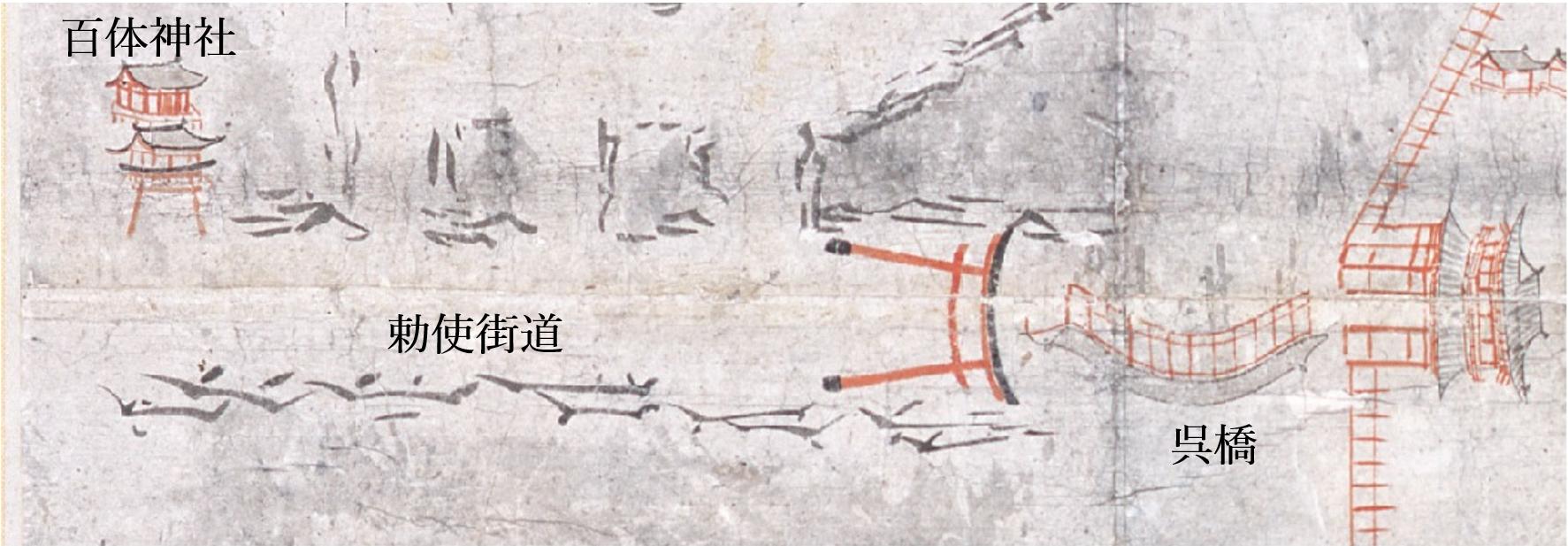
Hyakutai Shrine depicted in a map of the Muromachi period, the “Ōei Kozu” (Source: Usa City)
Send a comment
Comments are not published on this page. They go directly to the site owner.