
While Usa Jingu was steadily growing in influence, another community was quietly taking root across the Kunisaki Peninsula.
The monks had arrived.
Buddhism as an Arm of the State
In the capital of Nara, Buddhism had become an important institution of the state. Great temples were built with imperial support. Monks were officially recognized and regulated by the government. They studied Buddhist scriptures, performed state ceremonies, and prayed for the peace and stability of the nation.
Buddhism was not only a personal faith. It had become part of the machinery of government.
A Buddhism That Came by Sea
But the Buddhism that spread through Usa and Kunisaki was different.
Long before Buddhism became closely tied to the Japanese state, it had already been arriving in northern Kyushu little by little, carried across the sea by merchants, immigrants, craftsmen, and monks from the Korean Peninsula and the Asian continent.
Many of those monks settled within local communities. Their temples were not isolated centers of learning. They became places where ordinary people gathered—for worship, for advice, and for practical help in everyday life.
This is not just a story told in later chronicles — the ground itself remembers. Around the Usa plain, the remains of temples dating back to the late seventh and early eighth centuries have been found — Kokuzo-ji, Hokyo-ji, and others — among the oldest Buddhist sites anywhere in Kyushu. These were not official temples built on government orders. They were raised by local clans, with local wealth. Before the state’s Buddhism ever reached this far, a Buddhism carried across the sea had already taken root here.
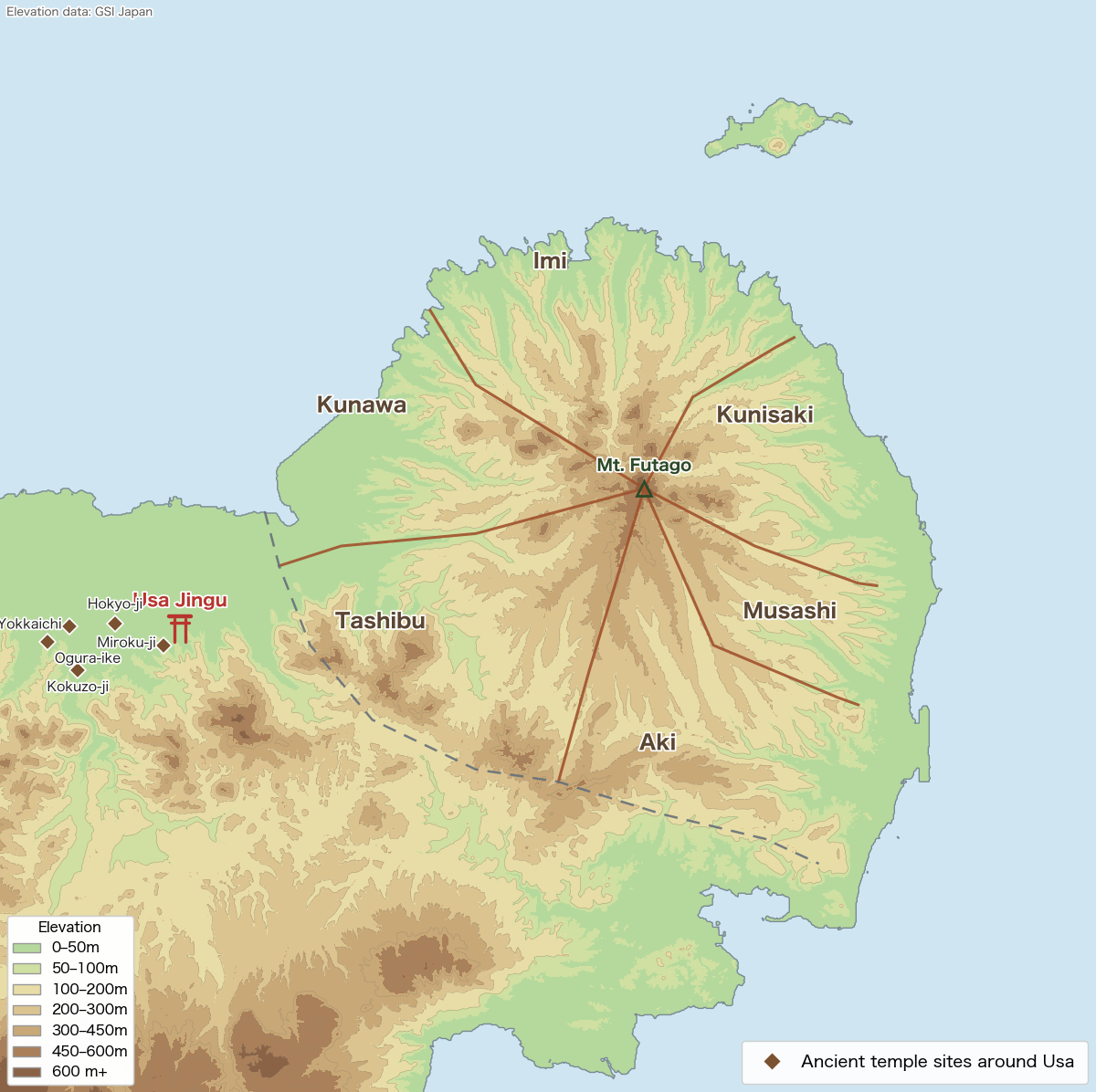
Ancient temple sites on the Usa plain — evidence of a Buddhism that arrived early, by sea
(all are archaeological sites, approximate locations. Elevation data: GSI Japan / click to enlarge)
In Kunisaki, Buddhism grew alongside the region’s older traditions rather than replacing them. It became a religion of the countryside.
A Religion That Helped People Live
The monks did far more than recite sutras.
They comforted the sick.
They prayed for rain during droughts.
They offered hope during famines.
Some passed on knowledge of medicine, engineering, or irrigation.
Others simply became trusted members of the communities they served.
For the people of Kunisaki, Buddhism was not an abstract philosophy. It was something that helped them live.
Maitreya: A Promise for the Future
One belief, in particular, found fertile ground here. It was devotion to Maitreya — Miroku in Japanese — the Buddha of the Future. According to Buddhist tradition, Maitreya will appear in a distant age to renew the world and bring salvation to all living beings. How distant? The scriptures say 5.67 billion years from now — a span of time that outlasts the sun. The belief had begun centuries earlier in India before spreading through China and the Korean Peninsula to Japan.
For people living in an age marked by war, disease, and famine, this promise carried enormous power. No matter how difficult life seemed today, a better world would one day arrive. Hope itself became an act of faith.
Maitreya’s faith sank deep roots in Usa. Centuries later, when a great temple finally rose beside Hachiman’s shrine, it would bear the name Miroku-ji — the Temple of Maitreya. Remember that name. How a Buddhist temple came to stand inside a Shinto shrine’s sacred grounds is the story of the next chapter.
Into the Mountains
Around the same time, another tradition was quietly taking shape in the mountains of Kunisaki.
Recall where this story began: these are the peaks the volcanoes made. The eruptions left towering crags and countless rock caves — iwaya — folded into the valleys. Sheer rock walls for testing body and mind; silent caves for solitary prayer. The volcanoes, as it turned out, had built a perfect training ground.
The mountains were not yet filled with great temples. Most temples remained close to the villages where people lived. The mountains served a different purpose. Monks climbed steep ridges, meditated in caves, prayed beside cliffs, and sought spiritual discipline in the natural world.
The mountains were not where they lived. They were where they transformed themselves.
Over generations, these practices gradually evolved into the mountain ascetic traditions that would later define Rokugo Manzan.
By now, Kunisaki had developed a form of Buddhism unlike that of the capital. It was rooted in local communities. It offered hope for ordinary people. And it found its sacred space not inside great cities, but among forests, cliffs, and mountain peaks.
Then something remarkable happened. This Buddhism encountered a land where ancient gods had already been worshipped for centuries.
Many cultures might have chosen between the old faith and the new one. Japan chose something entirely different. It did not choose between its gods and its Buddhas.
It imagined a world where both belonged together.
Worth a Visit: The Lost Temple in the Shrine Forest — Miroku-ji
For more than a thousand years, a full Buddhist temple stood inside the grounds of Usa Jingu. Miroku-ji was abolished in the Meiji era, when the government ordered Shinto and Buddhism separated, and today only its foundation stones remain — in a quiet lawn just south of the western approach, past the beautiful covered Kure Bridge.
Excavations show that Miroku-ji was a full-scale monastery laid out like Yakushi-ji in Nara, with twin pagodas standing before its main hall. The main hall enshrined the Buddha of Healing; the lecture hall, Maitreya. At its height, dozens of buildings stood here.
A great Buddhist temple, deep inside the sacred forest of a Shinto shrine — the quiet grass of this site is the best possible teacher of how recent our assumption is that shrines and temples are separate things. If you visit Usa Jingu, take the short detour.
What Miroku-ji looked like in its prime can be seen in a scale reconstruction of medieval Usa at the Oita Prefectural Museum of History (Usa city, near the shrine), in its permanent exhibition on the culture of Usa Hachiman.
Details: Miroku-ji site — Usa City (in Japanese).
Send a comment
Comments are not published on this page. They go directly to the site owner.