
Before there was a country called Japan, there were seas.
Far from separating people, the seas of East Asia connected them. The Seto Inland Sea, in particular, was one of the great maritime highways of the ancient world, carrying people, ideas, technologies, and beliefs from one shore to another.
People had already lived on the Kunisaki Peninsula for thousands of years. By the Jomon period, its mild climate, rich forests, abundant fishing grounds, and nearby sources of obsidian made it an attractive place to settle.
But the greatest transformation was still to come.
People and Technologies from Across the Sea
Beginning around the first millennium BCE, migrants from the Korean Peninsula brought with them rice cultivation, ironworking, new agricultural knowledge, and a more organized way of living in larger communities.
These were more than new technologies.
Rice farming required people to work together.
Iron tools changed agriculture and craftsmanship.
Knowledge of the seasons made harvests more predictable.
Gradually, these innovations reshaped the way people lived, cooperated, and governed themselves.
The Rise of Regional Cultures
Across the Japanese archipelago, different regional cultures embraced these new ideas in different ways. Rather than becoming identical, each region blended the newcomers’ knowledge with its own traditions, creating distinctive local cultures — in northern Kyushu, in Izumo on the Japan Sea coast, in Kibi and Kinai along the Inland Sea, and far beyond.
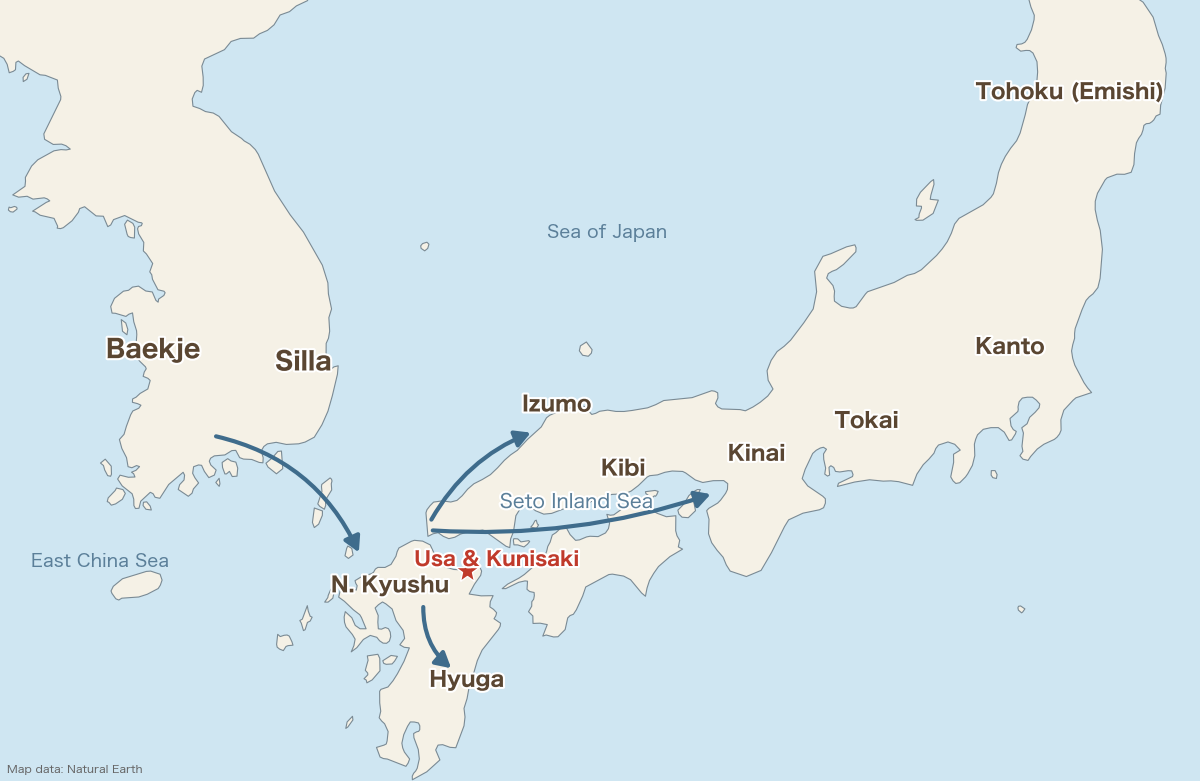
Crossing the sea, new ideas spread along the coasts, and distinctive regional cultures took root
(Map data: Natural Earth / click to enlarge)
Meanwhile, exchanges across the sea became increasingly dynamic. The Korean kingdoms, the Chinese mainland, and the peoples of the Japanese archipelago were no longer connected by one-way transfers of technology. Merchants, diplomats, craftsmen, monks, and migrants all carried their own knowledge, beliefs, and customs across the Yellow Sea and the East China Sea.
Japan was becoming part of a much larger East Asian world.
The Land of Toyo and Its Sacred Mountain
One of those regional cultures flourished in what was later known as Toyo Province — “the land of abundance” — including present-day Usa and the Kunisaki Peninsula.
Its location was ideal. Facing both the Seto Inland Sea and the Bungo Channel, Toyo stood at the crossroads of maritime trade and cultural exchange. Local leaders maintained connections with neighboring regions while preserving their own traditions and sacred places.
Long before Usa Jingu existed, one mountain already stood at the spiritual center of the region. That mountain was Mount Omoto, where the deity later enshrined at Usa is believed to have first been worshipped. Sacred mountains like this were among the earliest places where people sought the presence of the divine, centuries before large shrine buildings became common.
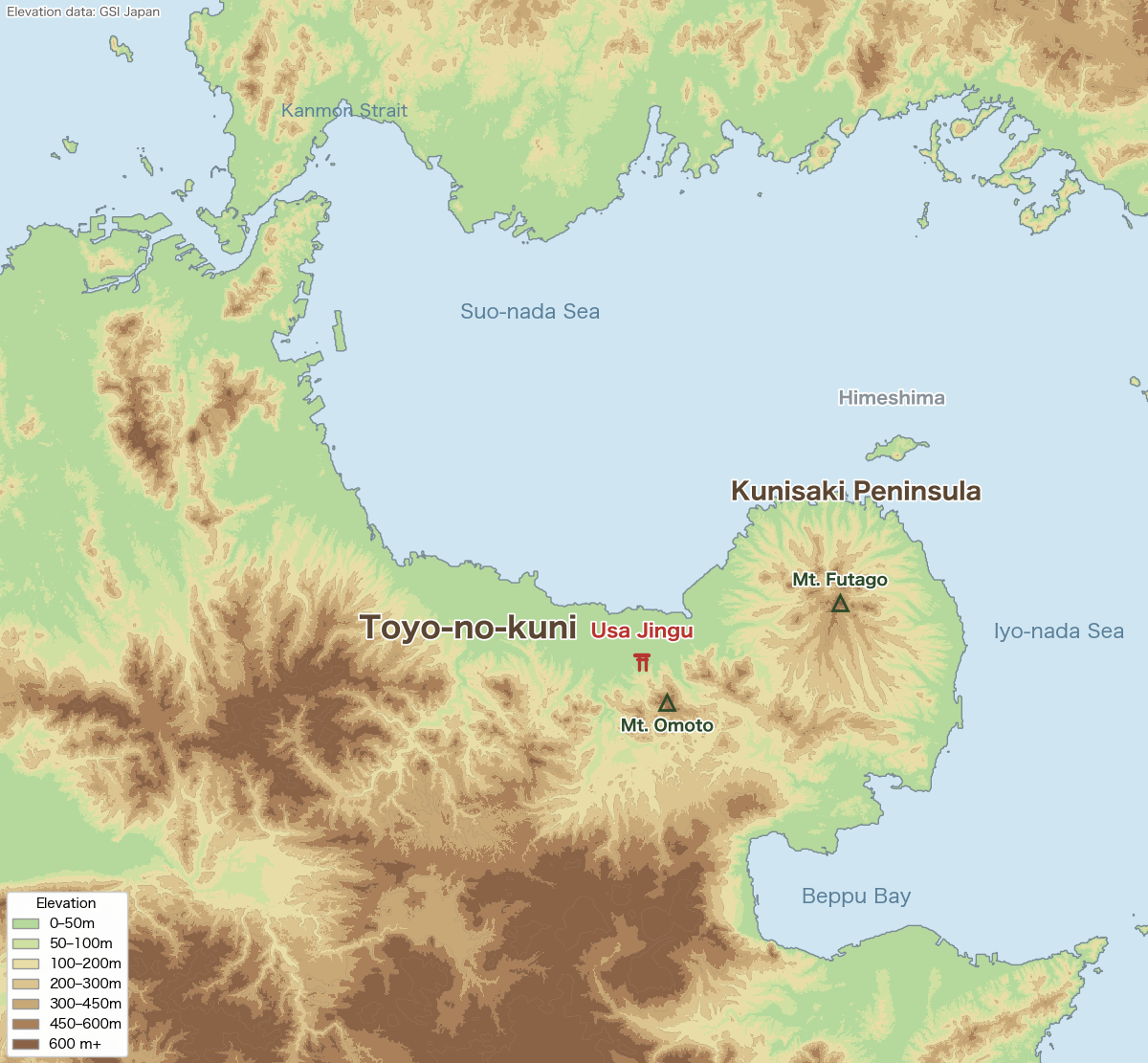
Around the calm Suo-nada Sea, the plains of Toyo run unbroken into the Kunisaki Peninsula
(Usa Jingu shown at its present location. Elevation data: GSI Japan / click to enlarge)
Asking the Gods: Ritual and Oracle
To sense a god’s presence in a mountain, and to offer it prayers — beliefs like these gradually took form as rituals that bound each community to its gods.
As communities grew through the Yayoi and Kofun periods, so did the decisions they faced: when to plant, how to share water, whether to risk a voyage, how to settle a dispute with neighbors. At such moments, people turned to their gods.
Readers familiar with the ancient Mediterranean may think of the oracle at Delphi — and the parallel is a good one. An oracle, takusen in Japanese, was not mere fortune-telling. It was the community’s most serious form of decision-making. Into the ritual place flowed the experience of elders, the reports of seafarers and traders, the judgment of ritual specialists, and the hopes of the community itself. What emerged, spoken as the will of a god, was an answer people could accept and act on together. The oracle was, in effect, ancient society’s mechanism for gathering wisdom and building consensus.
The Birth of Hachiman
Usa was perfectly placed for this role. It had a rich plain at its back, sea lanes to the Inland Sea and beyond, land routes across Kyushu — and, at the far end of those routes, the kingdoms of Korea and China. Stories carried home by sailors, news brought by traders, the latest knowledge of farming and engineering: all of it flowed into the ritual grounds of Usa, and returned to the community in the form of oracles.
People prayed for harvests, feared floods, avoided wars — and sometimes prepared for them. With each answered prayer, a reputation grew: the god of Usa responds. Word spread among the chieftains of neighboring regions, and trust accumulated over generations.
Out of that long accumulation grew the deity we now know as Hachiman. Today Hachiman is one of the most widely worshipped deities in Japan — tens of thousands of shrines across the country bear the name. That extraordinary story began here, in Usa. In time, even the imperial court itself would come to seek the counsel of this god’s oracles.
In this era there was still no single “Japan.” Each region faced its own sea and its own mountains, and cultivated its own culture. The Kunisaki Peninsula, rooted in the ancient beliefs of Toyo and enriched by centuries of exchange across the sea, was quietly preparing for the remarkable religious world that would later emerge here — Usa Jingu, and the mountain monasteries of Rokugo Manzan.
The sea had brought more than people. It had brought the ideas that would change history.
Worth a Visit: Mount Omoto, the Wellspring of Usa Jingu
In the era of this chapter, Usa Jingu did not yet have the magnificent vermilion halls that visitors see today.
The center of worship was Mount Omoto (Omoto-san), about six kilometers south of the present shrine. People believed that the god dwelled in the mountain itself, and revered it as sacred ground.
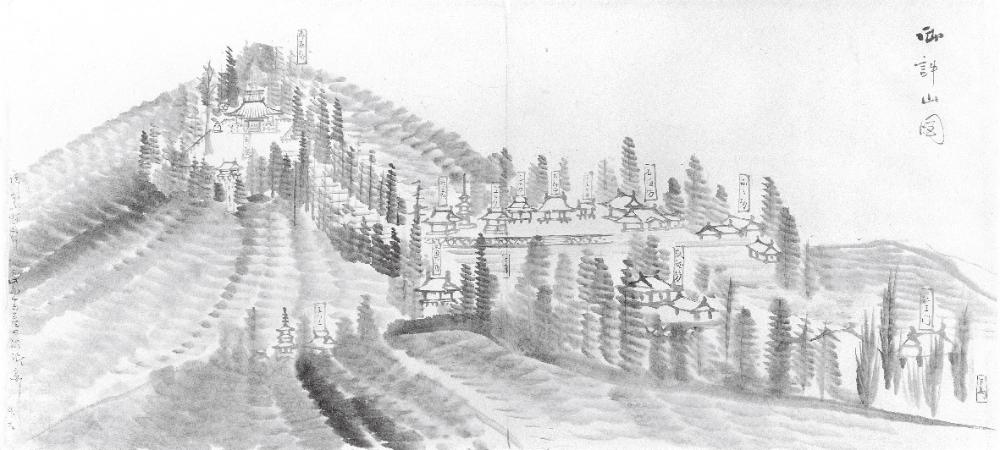
Mount Omoto in the illustrated diary of Minomushi Sanjin, a 19th-century wandering artist (Source: Usa City)
Today the summit is home to Omoto Shrine, the innermost sanctuary of Usa Jingu. Tradition holds that this is where Himeokami, one of the principal deities of Usa, first descended.
Mount Omoto remained a special place throughout the peninsula’s history. Temple communities once flourished on its slopes under Usa’s patronage, and when the Rokugo Manzan monastic culture later took shape, this mountain became one of its foundational training grounds.
Send a comment
Comments are not published on this page. They go directly to the site owner.