
1. What Exactly Is Rokugo Manzan?
Spend a day on the Kunisaki Peninsula and you will meet the words Rokugo Manzan everywhere — on temple signboards, on trail markers, in every brochure. Guides usually translate it as something like “the six-district mountain temples” and move briskly on.
Let’s not move on. This is the rabbit hole, after all. Taken apart, the four characters of 六郷満山 hide three good riddles: an administrative map as old as Nara’s Great Buddha, a Buddhist word for “everyone on the mountain” — and a name that is far younger than it looks.
”Rokugo” is six districts — on a 1,300-year-old map
In the eighth century, while the court at Nara was casting the Great Buddha, the young Japanese state was rolling out a Chinese-style administrative system: provinces, counties, and local districts called gō (郷). The Kunisaki Peninsula became Kunisaki County of Bungo Province, divided into six districts: Kunawa, Tashibu, Imi, Kunisaki, Musashi, and Aki. A tenth-century dictionary duly lists all six. That is “Rokugo”: the six gō.
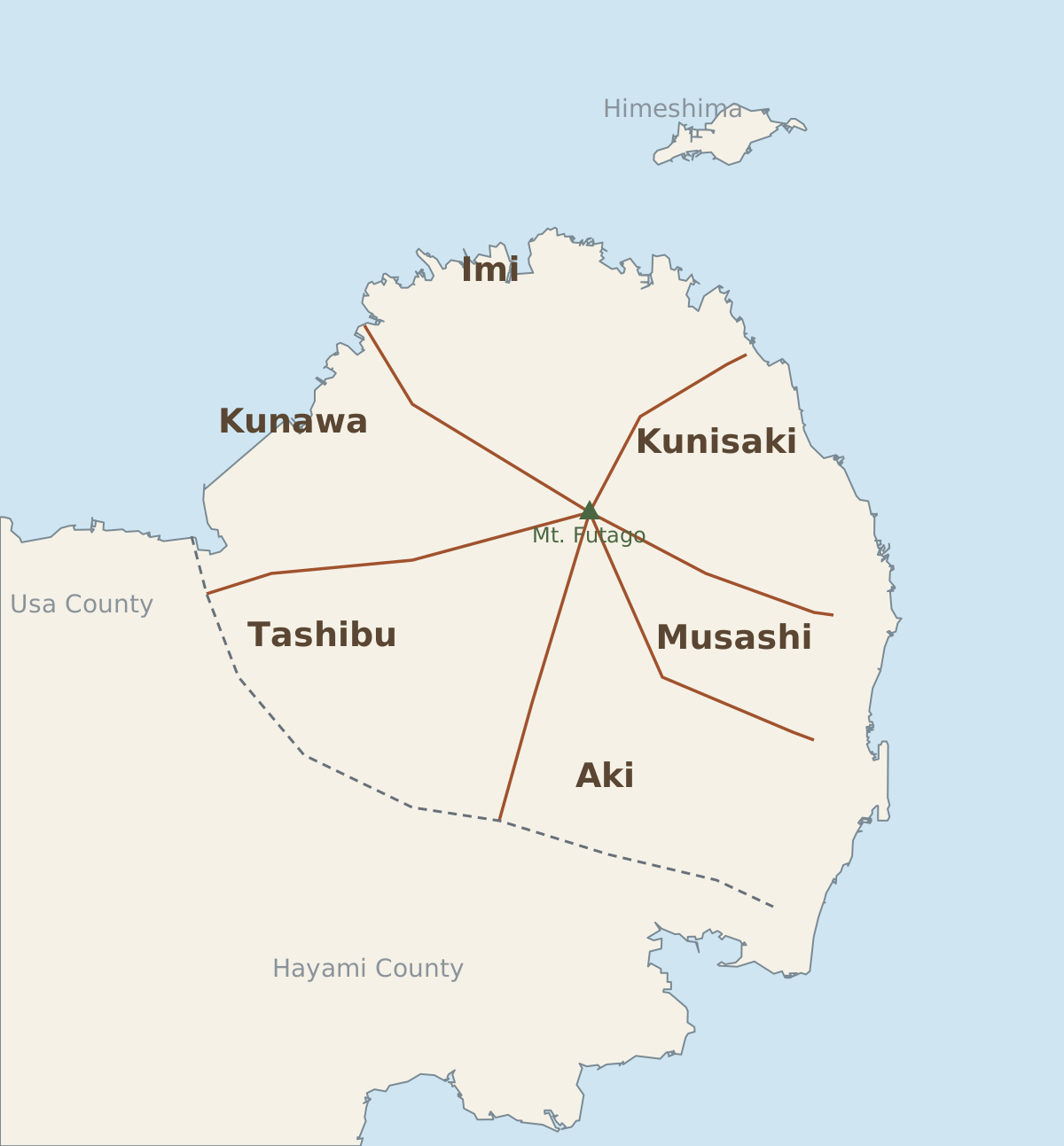
The six districts ringing Mt. Futago (approximate extents)
(map: © OpenStreetMap contributors / click to enlarge)
Look where the boundaries run. The six districts ring Mt. Futago, the extinct volcano at the peninsula’s heart — one district per fan of radiating valleys, the terrain we met in the first tale. The tax office, you might say, simply traced the lines the volcano had already drawn.
Those names are still on the mail
Here is the part I like best. All six district names are still in everyday use as addresses. The city of Kunisaki keeps Kunisaki, Musashi, and Aki as its town names; Imi lives on in Kunimi Town; Bungotakada keeps Tashibu and Kunawa.
England still calls its towns Chester and Lancaster after Roman army camps. Kunisaki goes one better: here, virtually the whole eighth-century district map survives intact, and people write those names on their parcels every day. A 1,300-year-old address book, still in service.
So who named the mountains after a tax map?
Now the second riddle. In the medieval registers and temple rosters — written from around the twelfth century onward — the temple network calls itself Rokugō-san, “the Mountains of the Six Districts.” Nobody in Nara or Kyoto assigned that name. The monks chose it themselves.
And there is a lovely irony in the choice. These were estate lands that had quietly slipped out of the state’s tax system — the “Donate the Name, Keep the Land” world of the fourth tale. Yet when those same communities needed a name, they reached for the state’s own administrative label. Not defiance, not submission — they simply borrowed the official signboard and put it to work. This is speculation, to be fair. But it smells like the same canny instinct.
One more detail: when the temple precincts were recently designated a National Historic Site, the official name chosen was “Rokugō-san” — exactly as in the medieval sources. Scholars and officials still use the old name.
Then where does “Manzan” come from?
Manzan — literally “the whole mountain” — is a Buddhist collective noun: all the temples and all the monks of a sacred mountain, taken as one body.
And here is the third riddle’s answer: the four-character combination “Rokugo Manzan” only became common in modern times. Right through the Edo period, the documents say “Rokugō-san.” The famous name on all the brochures is really a modern welding of two worlds — a bureaucrat’s district map and a monk’s word for the mountain community.
Which, honestly, makes it a rather perfect name. The administrative grid and the world of prayer, fused into a single word: 1,300 years of this peninsula, in four characters.
Today’s haul from the rabbit hole
- Rokugo = six eighth-century districts (Kunawa, Tashibu, Imi, Kunisaki, Musashi, Aki) — still valid addresses today
- In the sources, the network’s name for itself is Rokugō-san — a self-chosen name, and still the official one on the National Historic Site register
- “Rokugo Manzan” is a modern coinage: a tax map plus a Buddhist word, welded together
Next question down the hole: the monk who is said to have founded all twenty-eight of these temples in a single year — Ninmon Bosatsu. Who was he? And more to the point: who has been telling his story, and why? That’s the next dig.
Send a comment
Comments are not published on this page. They go directly to the site owner.